
Most Pennsylvania real estate agents earn between $40,000 and $95,000 a year, with first-year agents typically earning under $15,000 and established full-time producers clearing $100,000 or more.
There is no salary income; it comes entirely from commission, and Pennsylvania’s average total commission is about 5.77% of the sale price, split between two brokerages before you see a dollar of it.
Key Takeaways
- Published “average” salaries for Pennsylvania agents range from $48,386 to $153,955, depending on who is counting. The gap is a methodology problem, not a mystery.
- On a median-priced Pennsylvania home, a new agent on a 50/50 split takes home roughly $3,100 after tax per side.
- Experience is the single biggest income variable. National data shows roughly a tenfold spread between new agents and sixteen-year veterans.
- The typical agent closes nine transaction sides a year, so a $100,000 income at a standard new-agent split requires about two and a half times the median production.
- Your first commission check realistically lands five to eight months after you begin the licensing process.
I have taught the 75-hour pre-license course in Philadelphia for years, and there is one question that always comes before anyone asks about the exam, the contract, or the law.
It comes up in the parking lot, usually quietly, usually from someone who is still employed somewhere else.
Can I actually live on this?
That is a fair question, and it deserves a real answer.
What you will find on most pages ranking for it is a single figure lifted from one salary aggregator, presented without context, chosen because it looks encouraging.
That is not useful to someone deciding whether to leave a job with a steady pay cheque.
So this guide does something different.
It shows you every number, explains why they disagree, walks the actual arithmetic on a Pennsylvania home at Pennsylvania prices, and tells you what lands in your bank account after the broker, the IRS, and Harrisburg have all taken their portion.
Some of it is encouraging. Some of it isn’t. All of it is checkable.
The Six Numbers Pennsylvania Agents Get Quoted
And Why They’re All Technically True
Search “real estate agent salary Pennsylvania”, and you will get six answers spanning more than $100,000. Here they are side by side.
Every one of those numbers was honestly produced.
They disagree because they are measuring different populations.
| Source | Reported PA Figure | What It Actually Measures | The Catch |
|---|---|---|---|
| BLS OEWS (May 2024) | $60,590 mean | W-2 employed sales agents | Excludes self-employed workers, which is most of the profession |
| Salary.com (2026) | $48,386 | Modeled the salaried “sales agent” role | Models a salaried job that barely exists in residential real estate |
| NAR Member Profile (2026) | $59,200 median gross | REALTOR® members nationally | National figure, not Pennsylvania-specific |
| ZipRecruiter (2026) | $85,999 average | Derived from job postings | Postings advertise potential, not outcomes |
| Indeed (2026) | $96,309 average | Self-reported by users | People doing well report their income; people who aren’t, don’t |
| Glassdoor (Feb 2026) | $153,955 total pay | Self-reported total compensation | Small sample, strong upward bias |
Every one of those numbers was honestly produced.
They disagree because they are measuring different populations.
Why is the spread so wide
Mean versus median.
A small number of very high producers pull averages upward hard.
In a commission business, the mean is almost always the flattering number, and the median is the honest one.
Who gets counted?
Federal wage data is built from employer payroll records. Since roughly 87% of REALTORS® are independent contractors rather than employees, Bureau of Labour Statistics figures structurally undercount the people actually doing this work.
That is not an error; it is a scope limitation, and almost nobody quoting BLS mentions it.
Licensed versus active.
Pennsylvania has far more licensees than working agents.
A large share of licence holders close zero or one transaction in a given year. Some got licensed to buy their own home, some to do a favour for family, and some tried it and drifted away.
Include them and the average sinks. Survey only working professionals, and it climbs.
Gross versus net.
Nearly every published figure is gross commission income.
Before expenses. Before the self-employment tax. We will fix that further down.
The range I actually give students
Here is what I tell people who ask me directly.
It is deliberately unglamorous, and it reflects what I have watched happen to people I have licensed and worked alongside in the Philadelphia market.
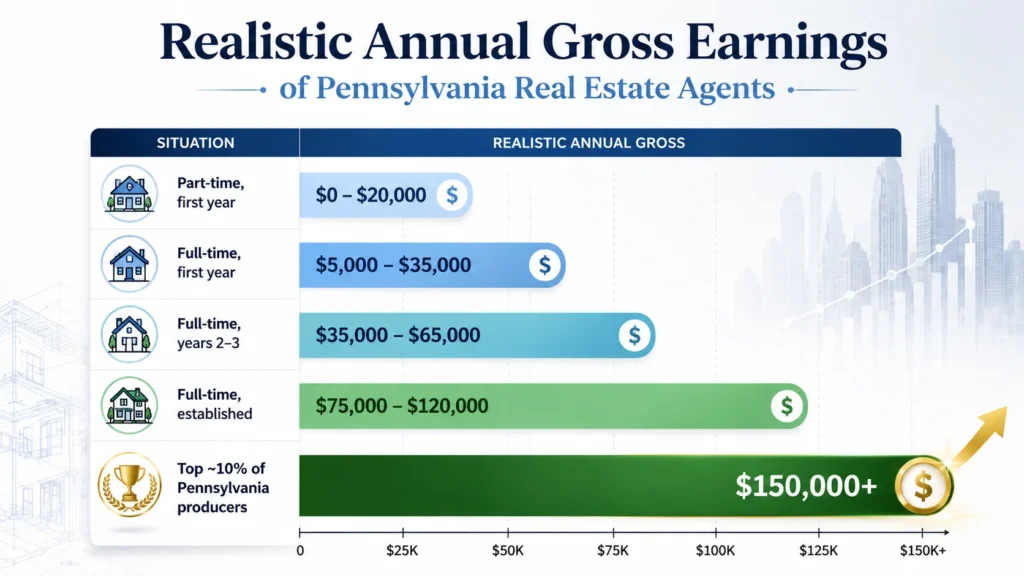
Notice that the first row includes zero. That is not pessimism.
That is the single most common first-year outcome for someone who keeps their day job and treats this as a side pursuit.
What a $320,000 Pennsylvania Sale Actually Puts in Your Pocket
This is the calculation almost nobody shows you, and it is the one that answers the real question.
Pennsylvania’s median home sale price reached $320,000 in May 2026, according to the Pennsylvania Association of REALTORS®, up roughly 5% year over year from $305,000.
Let’s run a median sale all the way through to your bank account.
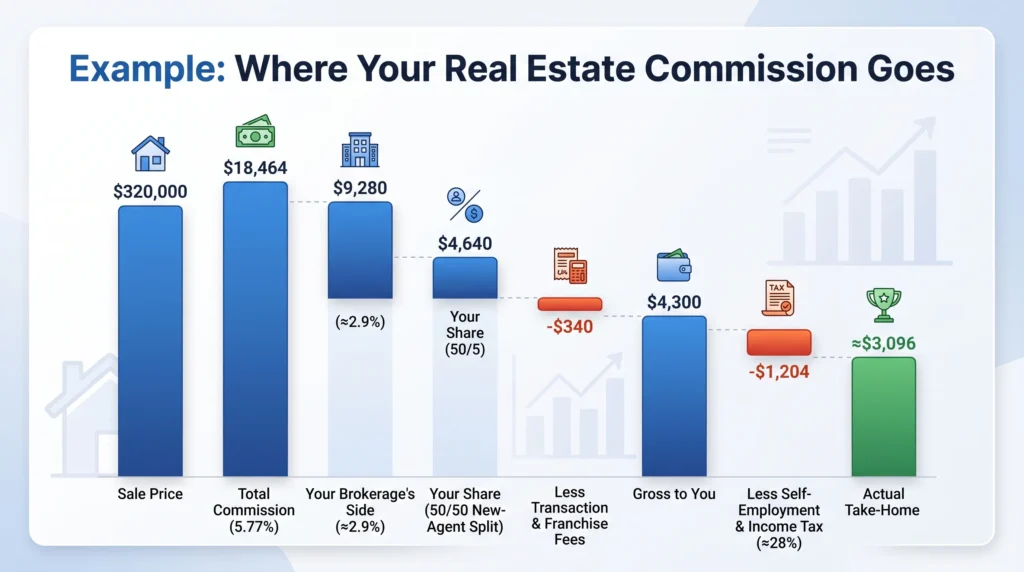
An $18,464 commission became roughly $3,100.
That is not a trick, and nobody is stealing from you. That is the structure.
Two brokerages split the fee. Your broker splits their half with you. You are self-employed, so nothing was withheld along the way, and the tax bill arrives all at once.
What experience is worth, in dollars
Run the identical sale at better splits and watch what happens.
| Your Split | Gross To You | After Tax |
|---|---|---|
| 50/50 (new agent) | $4,300 | ~$3,100 |
| 70/30 (producing agent) | $6,150 | ~$4,430 |
| 80/20 (strong producer) | $7,080 | ~$5,100 |
| 100% with desk fee | $9,130 | ~$6,570 |
Same house. Same paperwork. Same hours. More than double the money.
Your commission split is the highest-leverage number in your business, and most new agents never negotiate it largely because nobody tells them it is negotiable.
It is. Not on day one, when you have no production to point to. But by the end of a solid second year, absolutely.
A representative Philadelphia transaction
Take a rowhome in a middle-market Philadelphia neighbourhood for $285,000, which is close to the city’s median.
Total commission at the state average is about $16,400.
The listing broker takes roughly $8,400 of that. A new agent at 50/50 sees $4,200, minus a few hundred in transaction fees and minus tax; call it $2,800 in hand.
That deal took eleven weeks from first showing to settlement.
Fourteen showings, two failed offers, one inspection negotiation, and a lender who moved the settlement date twice.
I am not telling you that to discourage you.
I am telling you because “$16,400 commission” and “$2,800 for eleven weeks of work” are the same transaction described honestly and dishonestly, and you should know which one you are being sold.
Your Commission Passes Through Four Sets of Hands
Before It’s Yours
The gap between the number on the settlement sheet and the number in your account confuses more new agents than any other part of this business. There are four stages.
The total commission is set and split between brokerages
Pennsylvania’s average total commission runs about 5.77%, according to Clever Real Estate’s February 2026 survey of local agents, roughly 2.97% to the listing side and 2.80% to the buyer’s side.
A separate 2025 FastExpert survey put the state closer to 5.44%. In practice, most Pennsylvania transactions land somewhere between 5% and 6%.
Commission rates are not set by law in Pennsylvania. They never have been.
They are always negotiable, and telling a client otherwise is a licensing problem, not just a bad look.
Your brokerage splits its side with you
This is governed by your independent contractor agreement. New agents at full-service brokerages commonly start at 50/50 or 60/40.
The trade is real: you are buying training, supervision, a brand people recognise, and a broker who picks up the phone when a deal goes sideways at nine o’clock at night.
Common structures in Pennsylvania:
- Traditional split 50/50 or 60/40 with full support and training
- Graduated split improves as you cross volume thresholds
- Capped split 70/30 until you have paid the broker a set annual amount, then 100% for the rest of the year
- Desk fee / 100% flat monthly fee: you keep the commission, minimal support
- The team split is a lower percentage, but leads are supplied
Fees come off the top
Transaction fees, franchise fees, and errors-and-omissions insurance are typically deducted per deal. Usually a few hundred dollars, occasionally more.
You pay your own taxes
Nobody withholds anything on your behalf. You owe self-employment tax at 15.3%, federal income tax, Pennsylvania’s flat 3.07% state income tax, and local earned income tax, which for Philadelphia-based agents is meaningfully heavier than in the surrounding counties.
Quarterly estimated payments are required, and the first year people skip them is the year they get a genuinely unpleasant April.
When do you actually get paid?
At settlement. Not at listing, not at contract, not at inspection.
If a deal dies at the appraisal after you have put in eleven weeks, you are paid nothing for those eleven weeks. This is the part of the job that people who have never done it consistently fail to price in, and it is worth sitting with before you make a decision.
You pay your own taxes
Nobody withholds anything on your behalf. You owe self-employment tax at 15.3%, federal income tax, Pennsylvania’s flat 3.07% state income tax, and local earned income tax, which for Philadelphia-based agents is meaningfully heavier than in the surrounding counties.
Quarterly estimated payments are required, and the first year people skip them is the year they get a genuinely unpleasant April.
When do you actually get paid?
At the settlement. Not at listing, not at contract, not at inspection.
If a deal dies at the appraisal after you have put in eleven weeks, you are paid nothing for those eleven weeks. This is the part of the job that people who have never done it consistently fail to price in, and it is worth sitting with before you make a decision.
What PA Agents Earn in Year 1, Year 3, and Year 10
Experience predicts income more reliably than city, broking, or market conditions.
The National Association of REALTORS® 2026 Member Profile makes the pattern difficult to argue with.
| Career Stage | Typical Gross | Sides Per Year | What’s Driving It |
|---|---|---|---|
| Year 1 | $0 – $20,000 | 0–3 | No sphere, no referrals, still learning the Agreement of Sale. |
| Years 2–3 | $30,000 – $60,000 | 4–8 | First repeat clients and referrals begin trickling in. |
| Years 4–7 | $60,000 – $100,000 | 8–14 | Sphere compounding, taking listings. |
| Years 8–15 | $85,000 – $140,000 | 12–20 | Listing-heavy, leveraging help. |
| 16+ Years | $88,500 median → $250,000+ | 15–30 | Referral-driven, near-zero lead cost. |
The first year number nobody puts in their marketing
NAR reports that REALTORS® with two years or less experience had a median gross income of $8,000 in 2025.
Eight thousand dollars. Median, meaning half of them earned less than that.
I put that figure in front of every class I teach, and I want to be precise about what it means.
It is not evidence that the business doesn’t work. It is evidence of a pipeline that has not filled yet.
Real estate income lags effort by four to six months at minimum, so a first year that starts in March is really a nine-month year with a six-month delay built into the front of it.
The number is low because the calendar is working against you, not because the people are failing.
Why year three changes everything
By year three, a working agent has a database. Past clients refer friends.
Referrals cost nothing to acquire, convert at several times the rate of purchased leads, and arrive already sold on working with you.
That is the entire game. NAR’s veteran cohort, sixteen years and up, reports a median gross income of $88,500, up sharply from $78,900 the prior year, in a market that was difficult for everybody.
Those agents are not working harder than the new agents. They are working a book of business that took a decade to build.
The Same Deal Pays Differently in Philadelphia Than in Erie
Commission is a percentage, so the price point of your market sets your ceiling per transaction.
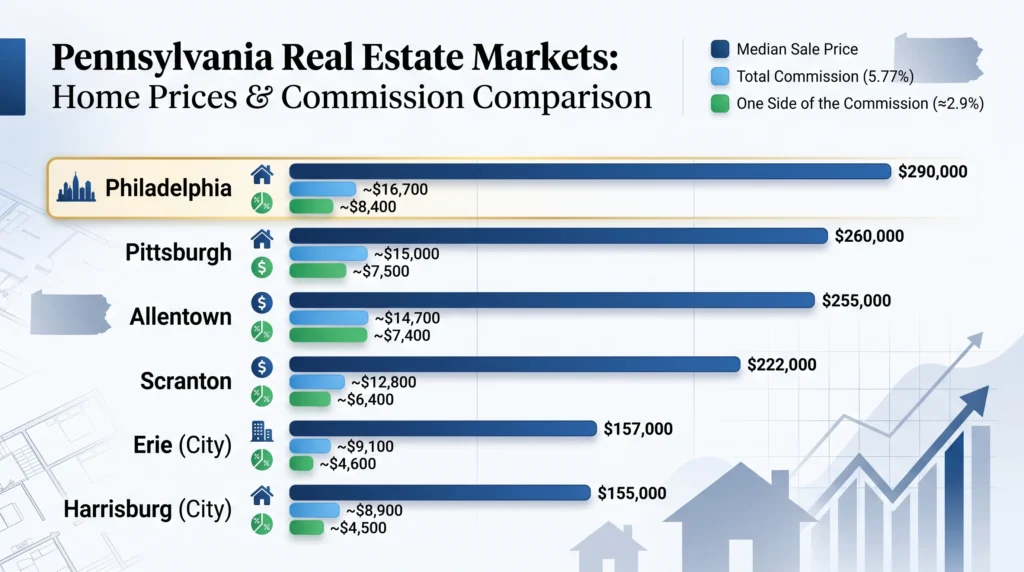
Suburban and county-level figures run considerably higher than the city numbers above.
Erie County as a whole sat near $227,000 over the same period against $157,000 inside the city, and the Philadelphia collar counties Montgomery, Chester, Bucks, and Delaware carry substantially higher medians than Philadelphia proper.
If you are choosing where to practise, look at the county figure, not just the city.
Philadelphia and the collar counties
The highest price points in the state, the highest transaction volume, and by a wide margin, the most competition.
Glassdoor’s Philadelphia figure of $170,128 is the highest in Pennsylvania, but understand exactly what that reflects: self-reported data from agents doing well enough to want to report it.
Philadelphia city agents also carry a heavier local tax load than agents working identical deals out of Montgomery County. Factor that in before you choose an office.
Pittsburgh and Western Pennsylvania
A lower median means lower commission per deal but also a lower cost of living and, in my experience, talking with agents out there, a stronger neighbourhood referral culture in established communities.
Volume matters more than price point west of the Alleghenies.
The small market advantage nobody mentions
A $155,000 median sounds like a problem until you realise an agent in a smaller Pennsylvania market can plausibly own 15% of a town’s transactions. Try owning 15% of Centre City.
Smaller markets also open land, farm, and small commercial work, which carry entirely different economics from residential resale, longer cycles but often have larger fees and far fewer agents competing for them.
How Many Sales Does $75,000 Actually Take?
Most people approach this backwards. They find an average, hope it applies to them, and stop thinking. Start instead with the income you need and work back to the transaction count.
Assumptions: Pennsylvania’s $320,000 median, 2.9% per side, before expenses.
| Income Target | At 50/50 Split | At 70/30 Split | At 100% + Desk Fee |
|---|---|---|---|
| $50,000 | ~11 sides | ~8 sides | ~6 sides |
| $75,000 | ~16 sides | ~12 sides | ~8 sides |
| $100,000 | ~22 sides | ~15 sides | ~11 sides |
| $150,000 | ~32 sides | ~23 sides | ~16 sides |
Now the context that makes this land. NAR reports the typical individual agent completed nine transaction sides in 2025.
Nine.
So a $100,000 year on a standard new-agent split requires roughly two and a half times what the median agent produces.
Not impossible; plenty of Pennsylvania agents do it every year but it is not a “work hard, and it happens” number. It is a build-an-actual-business number, and the difference matters enormously when you are planning your finances.
What twenty two transactions look like on a Tuesday
Twenty-two sides a year is roughly two closings a month, which means carrying six to ten active clients at any given time, with another twenty to thirty people in some stage of considering a move.
In practice, that is a Tuesday spent on three or four client conversations before lunch, a listing appointment in the afternoon, showings in the evening because that is when buyers are free, and an hour of follow-up calls to people who are not buying anything for another eight months.
Weekends are working days. Saturday mornings are showings and Sunday afternoons are open houses.
The people producing at that level are not doing anything exotic.
They are having a high volume of ordinary conversations, consistently, for years. That is the whole method, and it is far less glamorous and far more achievable than most marketing suggests.
The Expense and Tax Load Nobody Quotes
You are running a small business, not holding a job. NAR puts median annual business expenses at $9,530, with vehicle costs the single largest category at $1,580.
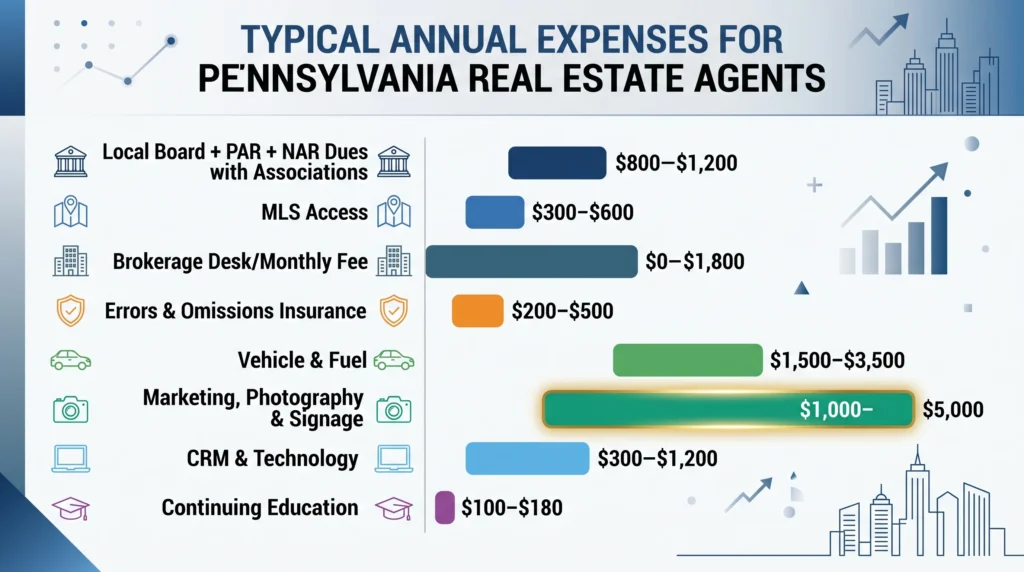
A first-year agent should budget $1,500 to $3,000 in operating costs. An established agent running real marketing spends $5,000 to $10,000 or more.
Gross to net
| Gross Commission Income | Est. Expenses | Est. Tax | Approximate Net |
|---|---|---|---|
| $40,000 | $8,000 | $7,500 | ~$24,500 |
| $75,000 | $10,000 | $16,000 | ~$49,000 |
| $120,000 | $14,000 | $28,000 | ~$78,000 |
For reference, NAR found that on a median gross of $58,100, the typical REALTOR® netted $36,600 after taxes and business expenses.
So when you see “$96,000 average” on a salary site, mentally translate: that is somewhere around $60,000 of actual money, and only if you are hitting that gross in the first place.
This is general information, not tax advice. Talk to a CPA who works with real estate professionals before you make decisions. A good one saves you more than it costs in your first year.
Month Zero to First Check: The Cash Flow Gap That Ends
Most Careers
More people leave this business over cash flow timing than over ability. Here is the actual timeline.
| Period | What’s Happening | Income |
|---|---|---|
| Months 1–2 | 75-hour course, exam, application, choosing a sponsoring broker | $0 |
| Month 3 | Licence active, onboarding, MLS access, first prospecting | $0 |
| Months 3–5 | First clients, showings, offers written and rejected | $0 |
| Months 5–6 | First contract accepted — Pennsylvania settlements typically run 30–60 days | $0 |
| Months 6–8 | The first commission check clears | First income |
Six to eight months from decision to money. If your first deal falls apart at inspection and first deals fall apart at a higher rate than experienced agents’ deals because you do not yet know how to deal with serious deals, add another two months.
This is why the under-two-year-olds cost $8,000. It is arithmetic, not aptitude.
What this means practically
Have six months of living expenses saved before you go full-time. Not three. Six.
Every year I watch capable people leave this business somewhere around month five who would have been genuinely good at it by month fourteen. They did not fail at real estate.
They ran out of runway, and a person with no runway starts making decisions out of panic, chasing unqualified buyers, taking overpriced listings, and spending money on leads they cannot afford.
That is the spiral, and it is financial before it is ever about skill.
Going part-time first, keeping income while you build a pipeline, is not a lack of commitment.
In Pennsylvania, it is legal, common, and frequently the smartest sequencing available to you.
The agents I have seen transition most successfully almost always had one of two things: savings or a household that could carry them through a lean year.
If you have neither yet, get one before you quit. That single decision changes the odds more than any course, brokering, or lead source will.
Why Some Agents Earn Five Times What Their Deskmate Earns

Same office, same market, same MLS access, wildly different incomes. Five things explain most of the gap.
Full time versus part-time
NAR reports a median of 35 hours per week across all members, with sales agents specifically at 30.
Part-time is legitimate and common, and it is the single largest reason published medians look low. If you intend to be full-time, compare yourself to full-time producers, not to the overall median.
Listings versus buyers
Buyer-side work is time-intensive and unpredictable. Dozens of showings, evenings and weekends, and a deal that can evaporate at any point.
Listing-side work scales. A listing agent can carry eight listings at once; nobody shows houses to eight buyers simultaneously and stays sane.
Agents who learn to take listings outearn agents who don’t, at every experience level. If you take one strategic idea from this article, take that one.
Solo versus team
NAR’s 2026 profile found 21% of REALTORS® working on a team, with a median team size of four.
The production difference is stark: nine median sides individually versus thirty-two for teams and a median sales volume of $2.7 million individually against $17.5 million for team-based broking specialists.
Teams supply leads and take a larger split. For a new agent with no sphere, that trade is frequently worth making: a smaller slice of deals that actually exist beats a large slice of zero.
Where your business comes from
Purchased leads convert at low single-digit rates and cost real money every month whether they close or not. Sphere and past-client referrals convert at many times that rate and cost nothing.
Every consistently high earner I know in Philadelphia runs on referrals. Every struggling agent I know is buying leads to fill a database they never took the time to build.
Specialization
- Luxury the Main Line, Chestnut Hill, Sewickley, Fox Chapel. Fewer transactions, much larger checks, and a long relationship-building runway before your first one.
- Longer commercial cycles, larger fees, and genuinely different skill sets and vocabulary.
- New construction sometimes has salaried on-site roles, which solves the cash flow problem at the cost of your ceiling.
- Land and farms are meaningful across central and northern Pennsylvania and consistently underserved.
- Property management recurring monthly revenue that smooths out the commission rollercoaster.
- Investors and multifamily repeat clients who transact several times a year rather than once a decade.
What Pennsylvania Brokers Earn And What It Takes to Get There

Brokers earn me through two mechanisms: they keep a larger share of their own transactions, and they can earn from other agents’ production.
Three broker paths
Associate broker. You hold a broker licence but work under someone else’s brokerage. Higher split, no management obligation. This is the most common upgrade and the easiest financial win available to a producing agent.
Managing broker or broker of record. You supervise agents. Often a salary plus an override on office production. Trades ceiling for stability, which suits some people very well.
Independent broking owner. You keep company dollars on every transaction in your office. The highest ceiling in the industry and, by a distance, the highest risk. You are now responsible for other people’s licenses and other people’s mistakes.
Getting there in Pennsylvania
The Pennsylvania State Real Estate Commission requires 240 hours of broker-level education plus a documented experience requirement three years of licensed activity along with a specified volume of qualifying transactions.
It is a substantial commitment. For an agent already closing consistently, it usually pays for itself inside a year through split improvement alone. If you are producing and have not looked at the broker path, look at it.
What It Costs to Start (and Keep) a Pennsylvania Real Estate Career
The entry cost is genuinely low. The operating cost is the part people underestimate.
One-time licensing costs
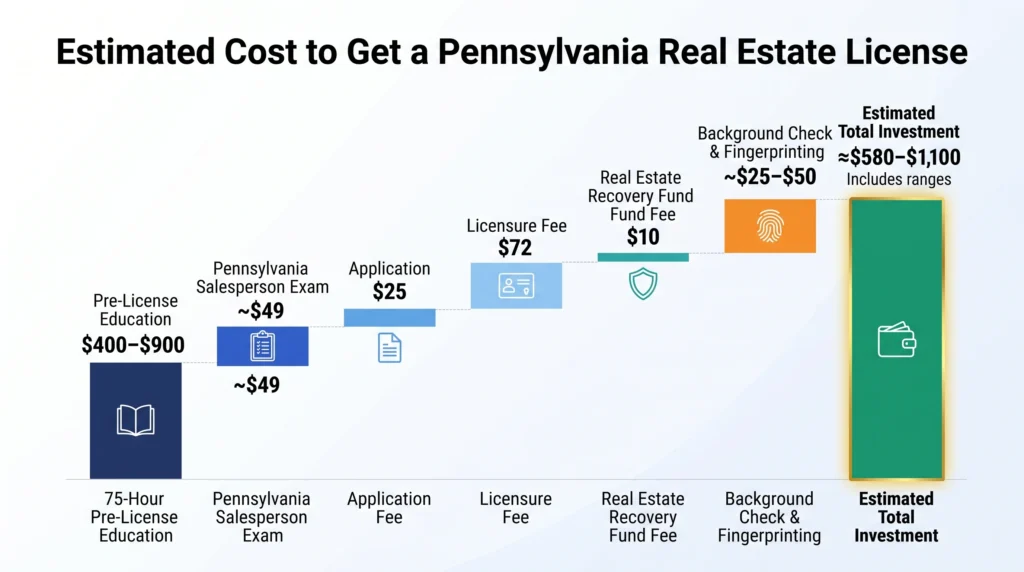
State fees change. Verify current amounts through the Pennsylvania Licensing System before budgeting.
Then the ongoing costs
Refer back to the expense table above. The licence costs under $1,100. Running the business costs $1,500 to $3,000 in year one and grows from there as you market more aggressively.
One requirement people miss
Pennsylvania requires 14 hours of post-licensing education during your first active renewal period, then 14 hours of continuing education every two-year cycle after that. Budget $100 to $180 per cycle.
Pennsylvania also holds reciprocity agreements with Arkansas, Georgia, Louisiana, Maryland, Massachusetts, and New York worth knowing if you live near a border or expect to relocate.
Is This a Good Career in Pennsylvania?
I am going to answer this the way I would if you were sitting across from me, because you deserve better than encouragement.
This works well if you:
- Have six months of expenses saved, or a household that can absorb a lean year
- Are genuinely comfortable with income that varies month to month
- Already know a lot of people in a defined Pennsylvania community
- Can prospect consistently when nobody is making you do it
- Treat it as a business with a marketing budget and a profit-and-loss statement, not as a job with flexible hours
This is a poor fit if you:
- Need predictable money next month
- Are hoping the licence itself will generate business
- Have no savings buffer and no financial backstop
- Dislike self-directed work with no external structure
- Are primarily motivated by the flexibility rather than the work
The honest summary is this. Pennsylvania real estate rewards patience and a network. It punishes people who are undercapitalised. And it is completely indifferent to how badly you want it.
The agents I know who built real incomes here are, almost without exception, people who survived long enough for their sphere to start producing. That is a financial question as much as a professional one.
If that sounds like a reason not to do it, good; that is useful information, and it costs you nothing to learn. If it sounds like a challenge you can meet, the barrier to entry is about a thousand dollars and eleven weeks.
Frequently Asked Questions
If commission is nearly 6%, why isn’t everyone doing this?
Because you don’t get 6%. On a $320,000 Pennsylvania sale, the 5.77% total comes to about $18,464, which splits between two brokerages, then splits again with your broker, then loses transaction fees, then loses roughly 28% to taxes. A new agent nets around $3,100.
The headline percentage and the take-home number are separated by four deductions.
How much do first-year real estate agents make in Pennsylvania?
NAR reports a median gross income of $8,000 for agents with two years or less experience.
Full-time first-year Pennsylvania agents who commit seriously typically land somewhere between $5,000 and $35,000. Those low figures reflect the pipeline lag, not the earning ceiling.
Should I quit my job to become a real estate agent?
Not immediately, in most cases. Pennsylvania permits part-time practice, and building a pipeline while still employed removes the financial pressure that pushes new agents into desperate decisions.
Go full-time when you have either six months of savings or a pipeline generating consistent contracts.
How long until I get my first commission check?
Realistically, five to eight months from the day you start your pre-licence course.
Roughly two months to get licensed, one to three months to your first accepted contract, then 30 to 60 days to settlement. If your first deal collapses at inspection, add two more months.
Do Pennsylvania real estate agents get a salary?
Rarely. You are an independent contractor paid on commission at settlement, with no withholding, no guaranteed minimum, and no employer benefits.
Three exceptions exist: on-site new construction sales roles, property management and leasing positions, and inside sales roles at large teams.
Is 20% of agents really earning 80% of the money?
Roughly, yes, and it holds across most commission-based sales fields.
The concentration is not primarily about talent.
It reflects who survived long enough to build a referral base and who is genuinely full-time versus casually licensed.
How many houses do I need to sell to make $100,000 in Pennsylvania?
About 22 sides at a 50/50 split, 15 at 70/30, or 11 on a 100% desk-fee model, using Pennsylvania’s median price.
For context, the typical agent nationally closes nine sides a year.
Can I do this part-time in Pennsylvania?
Yes, and many people do. Expect first-year income closer to $0 to $20,000, and understand the real constraint: buyers call during business hours, and sellers expect responsiveness.
Part-time works best when your primary job has genuine schedule flexibility.
Do I need to join NAR to be a real estate agent in Pennsylvania?
You need a licence from the Pennsylvania State Real Estate Commission.
NAR membership is separate and technically optional. In practice, MLS access usually runs through board membership, and MLS access is not optional.
Budget $800 to $1,200 annually for dues.
What’s the fastest way to increase my income as a Pennsylvania agent?
Two things, in this order. First, negotiate your split once you have production to justify it.
The same deal at 70/30 instead of 50/50 pays you 43% more for identical work. Second, learn to take listings. Listings scale; buyer work doesn’t.